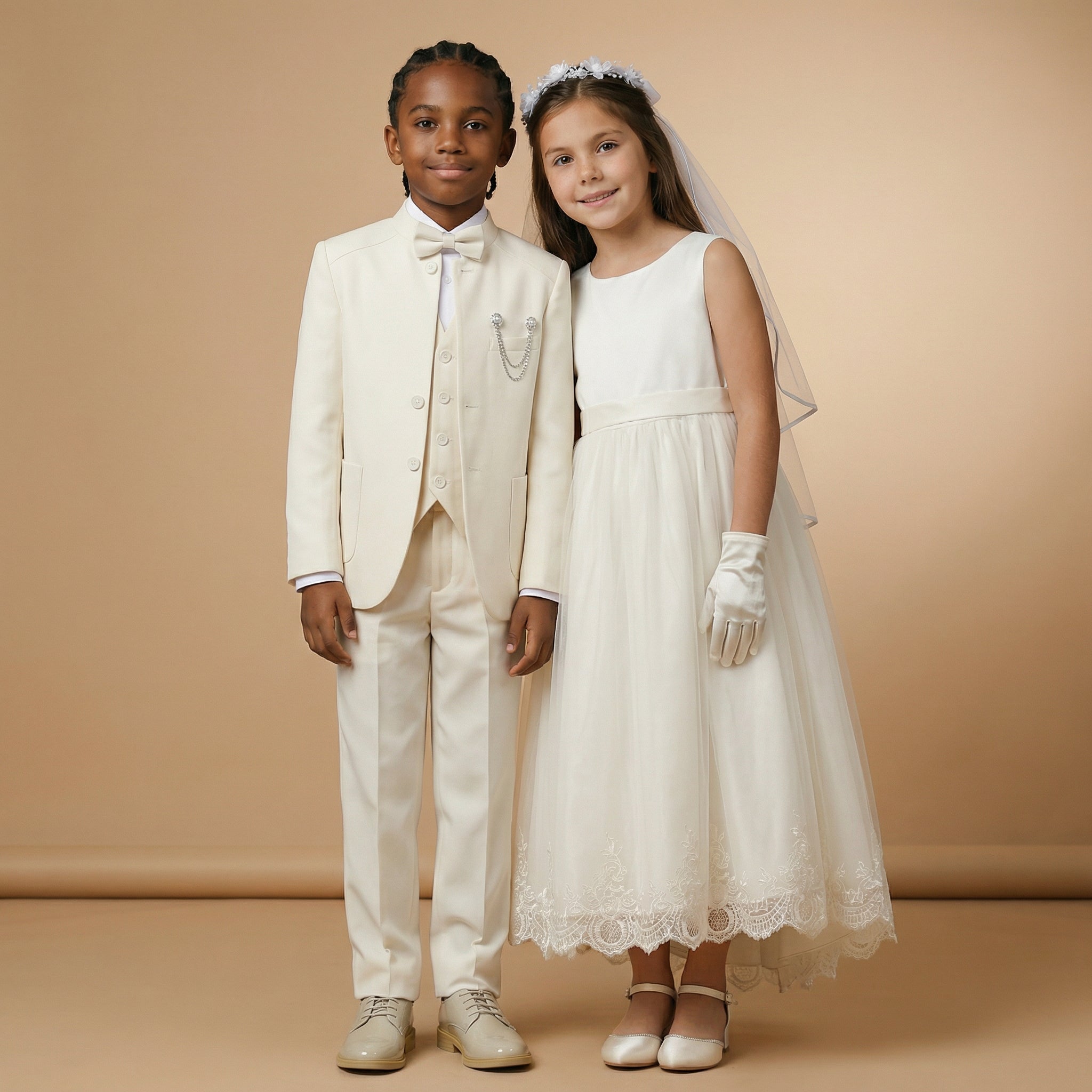
The Perfect Fit Guide: Communion Suits for Boys & Communion Dresses for Girls (Including “Between Sizes” Rules)
Communion is a special milestone in a young child’s spiritual journey. Naturally you’ll want them to look their best on the day. And you’ll want that for years to come in pictures as well. That’s why the outfit has to look good, photograph well, and fit nicely. Preparing for a communion as a parent can be intense (without another task added to the plate). Luckily, you don’t have to feel lost while figuring out the right fit. Most especially if your kid happens to fall in-between sizes. Whether you’re looking for a boys communion suit or a girls communion dress, this guide is created for you.
- 1. Boys Communion Suit Fit Checklist (the 60-second try-on)
- 2. Girls Communion Dress Fit Checklist
- 3. Is Your Child In-Between Sizes? The Simple Rule That Prevents Returns
- 4. Tailoring & Delivery Timeline: A Realistic Schedule
- 5. Dress Shoes: How to Break Them In Without Blisters
- 6. Accessories That Solve Real Problems
- 7. Frequently Asked Questions (FAQs)
Boys Communion Suit Fit Checklist (the 60-second try-on)

Start by having your son wear his boys first communion suit. Then, look for the following to ensure a proper fit:
- The blazer collar should rest comfortably against the shirt’s collar without any tightness or gaps around the neck and between the shoulders.
- Make sure that the blazer’s shoulders sit along his shoulders as well. If it drapes too low, it means the suit is too big, and if it hangs above his natural form, it means it’s too tight.
- A rule of thumb is that the jacket’s hem should cover his bottom, no more, no less.
- The optimal sleeve length is when the jacket’s sleeves sit only a bit above where the thumb bone meets his wrist, leaving some room for the shirt cuffs to slightly show (approximately about 1.5 cm).
- Lastly for trousers, they should smoothly drape over his bottom without any bunching of fabric underneath the buttocks (too big) or no drape (too tight). Trouser hems should have one break at most or no break, which happens to be the default in modern suit design. When the trousers are too short, the entire ankles become visible.
By following this quick checklist for how a suit should fit your son. You’ll ensure the suit’s silhouette is flattering and comfortable. Read our how to measure your boy for a boys suit guide for more in-depth tips.
Girls Communion Dress Fit Checklist

A first communion dress for girls should look polished, but it also has to feel comfortable through Mass. Use this checklist during a try-on at home (ideally with the dress shoes she’ll be wearing and any girls petticoat).
- Bodice comfort is essential; she should be able to breathe without the bodice restricting her rib or underarm movement. There should be no gaping in the neckline and armholes. Have her try sitting in it for a few minutes; there should be no fabric bunching into her neck, buttons straining, nor lace/tulle scratching against her skin. Lastly, ask her to raise her arms and hug herself to check the bodice fits nicely; it should neither pull upwards excessively nor feel restrictive.
- The waist seam of the dress should sit naturally around the waist or slightly higher; if it sits lower or rides up, then it’s not a good fit. Your girl should also be able to sit and bend while wearing the dress without the bodice pinching at the waistline.
- As for sleeves, cap or puff sleeves should not slide off the shoulder nor constrict the underarm. And if it’s a sleeveless design, the straps should lie flat against the shoulders and not gap. However, for the latter, it’s best to consult your parish, as some churches prefer to have the shoulders covered. If you’ve already purchased a sleeveless design that fits her well, no worries, as you can simply top it off with a satin bolero or cape for modesty.
- When it comes to the dress length, the most popular and accepted dress designs range from below-the-knee all the way to floor/full-length silhouettes. Check if she’s able to walk in the dress without kicking the hemline; go up and down the stairs to make sure it doesn’t catch or is too long.
- Lastly, it’s crucial to check the lining and opacity of the dress. Conduct a daylight and a flash check by having her stand next to a window facing direct sunlight and your phone's flash; the bodice and skirt shouldn't be see-through. If the dress feels light-coloured, consider pairing a petticoat underneath to improve opacity. Tulle, lace and beadwork often feel scratchy against a child’s delicate skin, so opt for a design that is satin lined for optimal comfort.
Is Your Child In-Between Sizes? The Simple Rule That Prevents Returns
Kids go through growth spurts, and it can be hard to determine which size suits them best. Sometimes they even fall in-between sizes. This doesn’t mean you can’t pick an outfit with a proper fit. You just have to figure a way around it.
For boys, a good rule is to pick the suit based on shoulder and chest measurements. Then, hem the trousers and sleeves if needed. At Sirri, we provide an exclusive line of husky-fit suits for boys. They’re an ideal pick whether your boy has a broader build and is larger than boys his age. Or is simply outgrowing his clothes faster than you can keep up.
If your girl is in-between sizes for a dress, it’s better to select the size that fits the largest measurement. Then, simply take in what is needed instead.
Tailoring & Delivery Timeline: A Realistic Schedule
All that said, it is imperative to purchase the suit or dress ahead of time. This way you won't miss out on the best styles available. You’ll also allow yourself a necessary buffer period if any fitting issues occur.
Here’s a realistic timeline:
- 1st try-on.
- Return or visit the tailor if necessary.
- 2nd and final try-on.
- Pressing/steaming the garment ahead of the event.
Below is a table for how long garment alterations take time:
| Type of Alteration | Estimated Time |
| Minor alterations (hemming, waist in/out) | 1–3 days |
| Moderate alterations (garment slimming, sleeve length) | 3–5 days |
| Major alterations (shoulders, full outfit adjustments) | 1–2 weeks |
Dress Shoes: How to Break Them In Without Blisters
It is essential that your child is able to wear the shoes for long hours without discomfort or pain. To achieve the best fit for dress shoes, measure both feet prior to purchase. While fitting for the communion dress shoes, let your kid try them on with socks/tights. This will ensure they’re the right match.`
Afterwards, break them in prior to the special occasion, at least by one week. Do that properly by letting your kid wear their communion dress shoes around the house for short bursts. Next, gradually increase the period until the pair can be worn comfortably without two socks on.
Lastly, protect their feet against blisters by following these two steps:
- Making sure that the feet fit snugly in the shoes with the laces/buckle closure pulled tight to prevent the feet from moving inside the shoes and causing friction, which develops blisters as a result.
- Using adhesive liners that stick to the shoes' heels, toes, and collar (in a pinch, band-aids would also do the work).
Accessories That Solve Real Problems
Accessories should earn their place by making the outfit more comfortable. As well as more appropriate for church and easier to wear, not just prettier.
Veils / headpieces
- Girls communion veils are optional in many parishes. However, if worn, they typically shouldn’t cover the face. Check your parish rules.
- For photos, pick a style that doesn’t slip: a headband or comb base usually holds better than a loose clip.
- Do a quick “shake + sit” test at home: let her turn her head side-to-side, look down, then sit/stand. If it moves, switch to a stronger base and add bobby pins.
Boleros & capes
- If the dress is sleeveless or strapless, a girls bolero or cape is the simplest way to add coverage without changing the dress.
- Some parishes ask for shoulders/arms covered and suggest adding a jacket or sweater, so this is a safe backup if you’re unsure.
Gloves
- Communion gloves are one of the most rule-sensitive details. Some parishes don’t allow them during Mass.
- If gloves are allowed, some guidelines require removing them before receiving the Eucharist (especially if receiving in the hand).
- Check your parish before buying.
Petticoats
- A girls petticoat helps the skirt sit better in photos and move smoothly (less catching on tights).
- It can also add comfort by creating a soft layer between skin and tulle/lace.


Frequently Asked Questions (FAQs)
1) What colour suit do boys wear for First Communion?
Traditional suit colours are white and ivory. However, modern communion suits include options such as beige, navy blue and light grey.
2) What length should a first communion dress be?
It should have a modest length (below the knee-length at least). Full-length dresses are also popular.
3) What if my child is between sizes?
If your child is in between sizes for a suit or dress, it’s better to select the size that fits the largest measurement of their body and then take in what is needed instead.
4) Do communion shoes need to be white or ivory?
Communion shoes should complement the outfit’s colour. For instance, if a dress is mainly ivory or has ivory accents, match the shoes by selecting ivory Mary Janes. On the flip side, if a dress is white, select white dress shoes.
5) Do communion dresses need sleeves?
First Communion mass values modesty, and traditional dresses have sleeves, or, if they happen to be sleeveless, a bolero or shawl is worn to cover the arms. However, it is best to consult your parish for the church’s communion dress code, as some churches allow for cap-sleeved communion dress designs.
6) When should I buy a communion suit/dress?
For a spring ceremony, it is best to purchase a communion suit for boys or a communion dress for girls in January (at least 3 months earlier), which is also when the best stock and styles are available. This will allow you time to try the outfit on your child and return/exchange it if the fit is inadequate. Any necessary alterations are also taken ahead of time, so it’s key as a parent to be prepared.
For more styling tips and exclusive updates,
follow us on TikTok and Instagram
@sirriuk